How to Cash Out From Base and Arbitrum to Your Bank Account: Fees, Routes, and Timing
The part nobody writes a guide for
Onboarding gets all the tutorials. Buy crypto, bridge to Base, swap on Arbitrum — there are ten guides for every dollar entering the system. The exit direction is comparatively quiet, which is odd because cashing out is where people lose money to network mistakes and where the 7-day bridge window actually ruins plans. I have done this exit dozens of times now, including one painful lesson where I picked the wrong network on an exchange deposit and waited nine days for recovery.
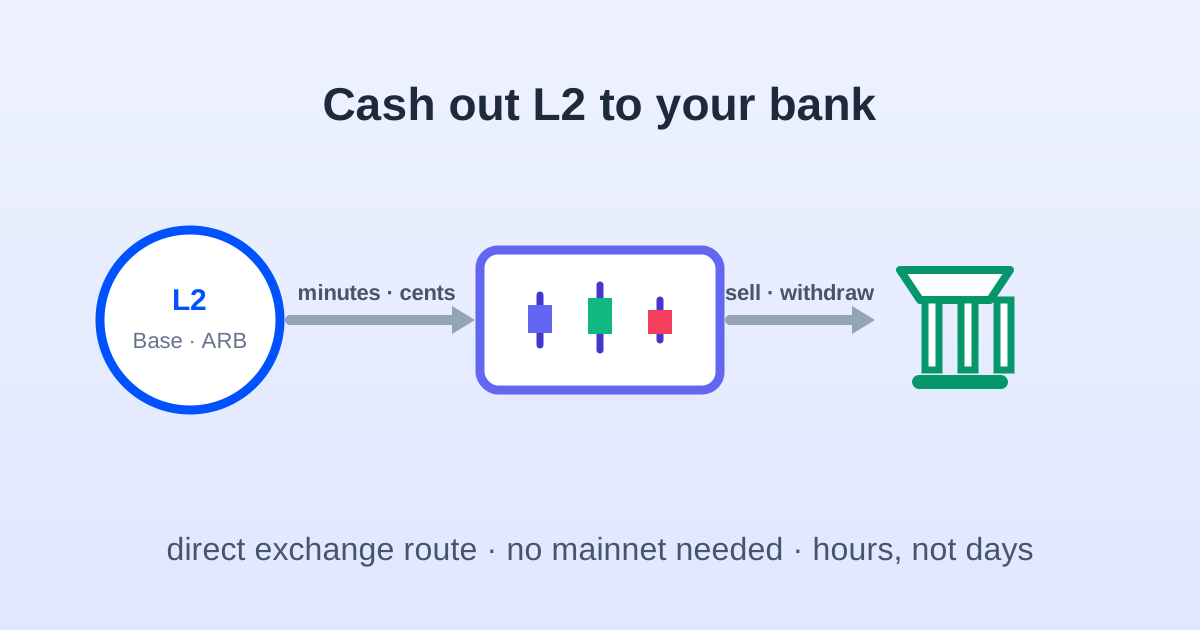
The good news: in 2026, cashing out from Base or Arbitrum is almost always a two-hop trip — L2 wallet to exchange, exchange to bank — with no Ethereum mainnet step at all. This article is the full route map: which path, which fees, which clocks. The inbound direction is covered in the exchange-to-Base guide; this is the reverse.
Route A: direct L2 withdrawal to an exchange (the normal way)
Every major exchange and most mid-sized ones accept direct deposits over Base and Arbitrum One for USDC and ETH. Your funds never touch Ethereum mainnet: you send from your wallet on the L2, the exchange credits the deposit after a handful of block confirmations — usually under five minutes — and you sell into fiat. Gas on the send is cents; the exchange may charge a small deposit-processing fee for some assets, though USDC deposits are commonly free.
Why this wins: mainnet fees never appear, there is no bridge, and there is no 7-day anything. The full cost stack collapses to a cent of L2 gas, the exchange's trading spread (typically 0.1-0.6% depending on how you sell), and the fiat withdrawal fee at the end. For a $5,000 cash-out the total friction is usually $5-30 all in, mostly the spread and the bank rail.
Route B: via Ethereum mainnet (only when forced)
A smaller exchange or an odd asset may only accept mainnet deposits. Then you face the optimistic-rollup exit: initiate an official bridge withdrawal, wait roughly seven days for the challenge window, pay L1 claim gas, and only then send to the exchange. The mechanics are in the Base withdrawal guide and the Arbitrum withdrawal guide.
For time-sensitive exits I never use the official bridge — a fast intent bridge delivers to mainnet in minutes for roughly 0.05-0.15% of the amount, and at $5,000 that fee buys a week of my attention back. I reserve the free official bridge for money I am moving without a deadline. If you can plan the cash-out a week ahead, the slow route costs nothing but calendar time.
The full cost stack, real numbers
| Step | Direct L2 route | Via mainnet (slow) |
|---|---|---|
| L2 send gas | $0.001-0.01 | $0.01-0.05 |
| Fast bridge fee | None | 0.05-0.15% or 7-day wait |
| L1 claim gas | None | $3-15 |
| Trading spread | ~0.1-0.6% | ~0.1-0.6% |
| Fiat withdrawal | $0-25 (rail-dependent) | $0-25 |
| Typical time | Hours | 7 days or minutes + fee |
The spread is the line worth managing. A market order on a quiet pair can cost 0.5% for no reason; a limit order at the top of the book on USDC/fiat typically costs a tenth of that. On $10,000 that single choice is a $40 difference, dwarfing every gas fee on the page.
The wrong-network deposit, and how to avoid it
This is the one mistake that turns a thirty-minute exit into a nine-day support ticket. If your exchange only credits USDC deposits on Base and you send USDC on Arbitrum to that deposit address, the funds may sit uncredited until manual recovery — assuming the exchange offers recovery at all. My own version of this story is in the wrong-network recovery guide, including what the support process actually looks like.
The prevention is boring and perfect: open the exchange's deposit page for the specific asset, read the network badge out loud, send to a whitelisted address, and test with $20 first. I also match the first six and last six characters of the pasted address against what the exchange shows — clipboard-replacing malware is a real thing, and the habit takes four seconds.
What to sell: USDC, ETH, or something else
My default is to swap everything to USDC on the L2 before cashing out. Stablecoin deposits are supported more widely, spreads are tighter, and you separate the "what price do I sell at" decision from the "how do I move money" logistics. The swap costs a cent on Base or Arbitrum per the USDC transfer guide, and moving canonical USDC across chains is free and clean via the burn-and-mint route in the CCTP guide.
Selling ETH directly is perfectly fine when its exchange pair is liquid and I wanted ETH price exposure until the last minute — one fewer swap, one fewer approval. I avoid cashing out random alt tokens through exchanges: deposit support is spotty, and when a token is delisted mid-transfer the recovery process is worse than wrong-network mistakes. Convert on-chain, then move the asset the exchange actually wants.
Timing the exit like a transaction, not a mood
Gas on L2 barely matters for cash-out timing. Three other clocks do:
- The market clock. I place the sell as a limit order during liquid hours rather than a market sell into a thin weekend book. On stables this is negligible; on ETH it is often the difference of tens of dollars.
- The bank rail clock. First-time bank linking carries anti-fraud holds. I connect and verify the bank account a few days before I need the money, so the actual withdrawal has nothing waiting on it.
- The tax clock. Cashing out is a disposal and a reportable event in most jurisdictions. I log the sale date, proceeds, and cost basis at the moment it happens — the record-keeping system in the L2 tax guide exists because trying to reconstruct this in January is miserable.
Done right, the whole thing is uneventful: test transfer, full transfer, sell, withdraw, money in the account the same or next day. The L2 promise was never just about cheap swaps — it was that moving your own money in and out of the system should cost pennies and take minutes. The exit, finally, is as easy as the entrance.
Trade on Base / Arbitrum with Low Fees
Choose a trusted platform to swap, bridge, and trade on L2 networks.
Affiliate links — we may earn a commission at no extra cost to you.