How to Bridge USDC Between Base and Arbitrum With CCTP (And Why I Stopped Putting Up With USDC.e)
The USDC.e annoyance that sent me looking
A while back I bridged stablecoins to Arbitrum through an older liquidity bridge and the token that arrived looked like USDC — same logo, same name, same $1 peg. It was only when I tried to repay a loan that the trouble showed: the protocol wanted native USDC, and what I held was "USD Coin (Arb1)", the old bridged token everyone calls USDC.e. I had to swap it, paying slippage and another approval, while the stablecoins I actually needed sat one hop away.
USDC.e is an IOU. A bridge locked real USDC somewhere and handed you a claim token on this chain. Native USDC on a rollup is the actual asset, minted by Circle under the same reserve. They both say "USDC" in your wallet. They are not interchangeable in contracts, and during stressed market hours the IOU trades at a small discount while liquidity pools thin out. After getting bitten twice, I switched all my stablecoin bridging to CCTP.
What CCTP actually does
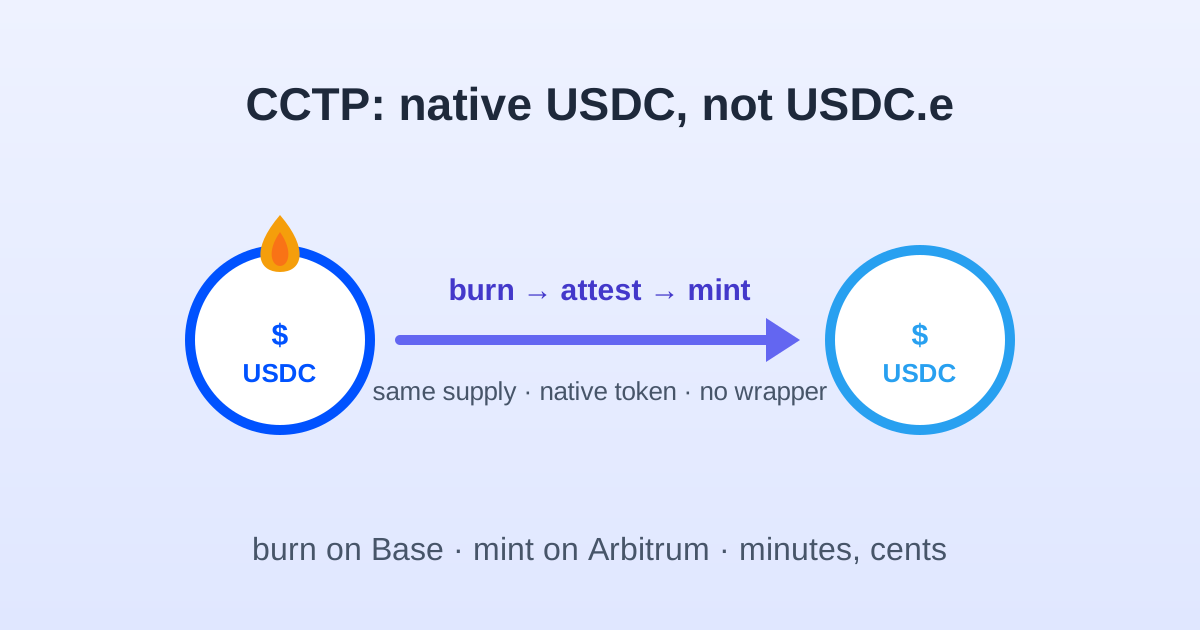
CCTP — the Cross-Chain Transfer Protocol run by Circle, the issuer of USDC — flips the bridge model. Instead of lock-and-wrap, it burns-and-mints. You initiate a transfer on the source chain, the USDC is permanently destroyed there, Circle's attestation service signs a message confirming the burn, and a fresh unit of native USDC is minted on the destination chain to your address. Supply never changes: one burned, one minted.
What this fixes in practice:
- No wrapper token. The asset that lands is native USDC, accepted everywhere native USDC is accepted — lending pools, perps margin, payroll, bill payments.
- No fragmented liquidity. You stop choosing between USDC/ETH and USDC.e/ETH pools with different depths.
- No depeg exposure. Bridged wrappers can wobble from their peg when bridge news breaks; the minted asset is USDC.
- No lockup contract for your specific transfer. The risk model is Circle plus the attestation signers rather than a pool of wrapped IOUs.
CCTP is live on the chains where most stablecoin movement happens — Ethereum, Base, Arbitrum, Optimism, Polygon, Avalanche and several more — and integrations keep adding, so Base↔Arbitrum is a first-class route, not a test case.
Costs and speed: CCTP vs the alternatives
Here is what moving 1,000 USDC between Base and Arbitrum costs through each route I actually use, based on my receipts from the past few months:
| Route | Protocol fee | Gas | Speed / receive asset |
|---|---|---|---|
| CCTP via Circle bridge | $0 | ~$0.01-0.05 | Minutes (attestation) · native USDC |
| CCTP via integrated fast UI | 0-0.1% | ~$0.01-0.05 | Near-instant · native USDC |
| Intent bridge (Across/Stargate) | 0.05-0.15% | ~$0.01-0.05 | 2-5 min · usually native, check label |
| Legacy lock-and-wrap bridge | 0-0.2% | ~$0.01-0.05 | Minutes · USDC.e wrapper |
On the L2-to-L2 trip, gas is a rounding error on every row, so the real differences are the receive asset and whether the protocol fee is zero or a tenth of a percent. For $1,000 that is a dollar — I happily pay it when I am in a hurry and the integrated route is instant; I use Circle's free self-serve bridge when I am rebalancing larger amounts and do not mind a short wait. The broader cost context, including sending USDC around within one chain, is in the USDC transfer cost guide.
How to tell native USDC from USDC.e
Wallets are aggressively friendly with token labels, which is how people end up confused. The only reliable tell is the contract address on the explorer:
- Native USDC on Base: 0x833589fCD6eDb6E08f4c7C32D4f71b54bdA02913 — branded "USDC" on Basescan.
- Native USDC on Arbitrum: 0xaf88d065e77c8cC2239327C5EDb3A432268e5831 — branded "USDC" on Arbiscan.
- USDC.e on Arbitrum: 0xFF970A61A04b1cA14834A43f5dE4533eBDDB5CC8 — branded "USD Coin (Arb1)".
If you currently hold the wrapper by mistake, the fix is boring: swap USDC.e to native on Uniswap or the local DEX (Aerodrome on Base, Camelot on Arbitrum), then bridge the native token properly next time. The Uniswap fee guide puts that swap at roughly a cent in gas; the approval before the first swap is explained in the approval guide.
Limits, timing, and the two gotchas that tripped me
CCTP enforces per-chain burn limits — a maximum per transaction and a rolling daily cap, sized to cover normal retail and institutional flow. Circle has raised these repeatedly as volume grew, so check the current numbers on the official CCTP docs before moving treasury-scale amounts; if a transfer would exceed the cap, the interface blocks it rather than queuing a surprise.
The two things that actually tripped me:
- Forgetting destination gas. USDC minted on Arbitrum with zero ETH in the wallet is the same trap as every L2 — you can see the money, you just cannot move it. I keep about a dollar of ETH on each chain permanently.
- Assuming every "CCTP" label meant instant. Circle's own bridge waits for the off-chain attestation before minting, normally minutes but occasionally longer during service hiccups. Fast front-ends pre-fund you from liquidity and settle behind the scenes. Neither is a problem once you expect it; just do not choose the self-serve route ten minutes before a payment deadline.
One more honest note: CCTP only moves USDC. For ETH and other tokens between these chains I still use the intent-bridge workflow covered in the Arbitrum bridging guide — pick the tool that matches the asset instead of forcing everything through one bridge.
My simple decision rule
Moving stablecoins between Base and Arbitrum: CCTP first, every time, because the asset that arrives needs no second step. I use Circle's bridge directly when I am at my desk and moving meaningful amounts — zero fee, a few minutes of attestation. I use a CCTP-routed fast integration when I am rebalancing on my phone mid-conversation, and I treat the sub-dollar fee as a convenience charge.
What I no longer do is accept USDC.e without a plan. If a route shows the wrapper as the receive token, I either switch routes or budget for the immediate swap into native. Stablecoins are supposed to remove friction from your day; holding a two-tier version of the same dollar quietly puts it all back.
Trade on Base / Arbitrum with Low Fees
Choose a trusted platform to swap, bridge, and trade on L2 networks.
Affiliate links — we may earn a commission at no extra cost to you.