Unichain vs Base in 2026: I Used Both for a Month, Here Is Where Each One Wins
Why I spent a month splitting my activity
Unichain launched as "the Uniswap chain," and like most people I assumed that meant a marketing gimmick — the same OP Stack code, a different logo, another network to add to my wallet. Then a friend kept posting swap receipts with confirmation times that looked like typos, so I moved half my trading float over and lived with the split for a month: swaps and trading on Unichain, everything else on Base.
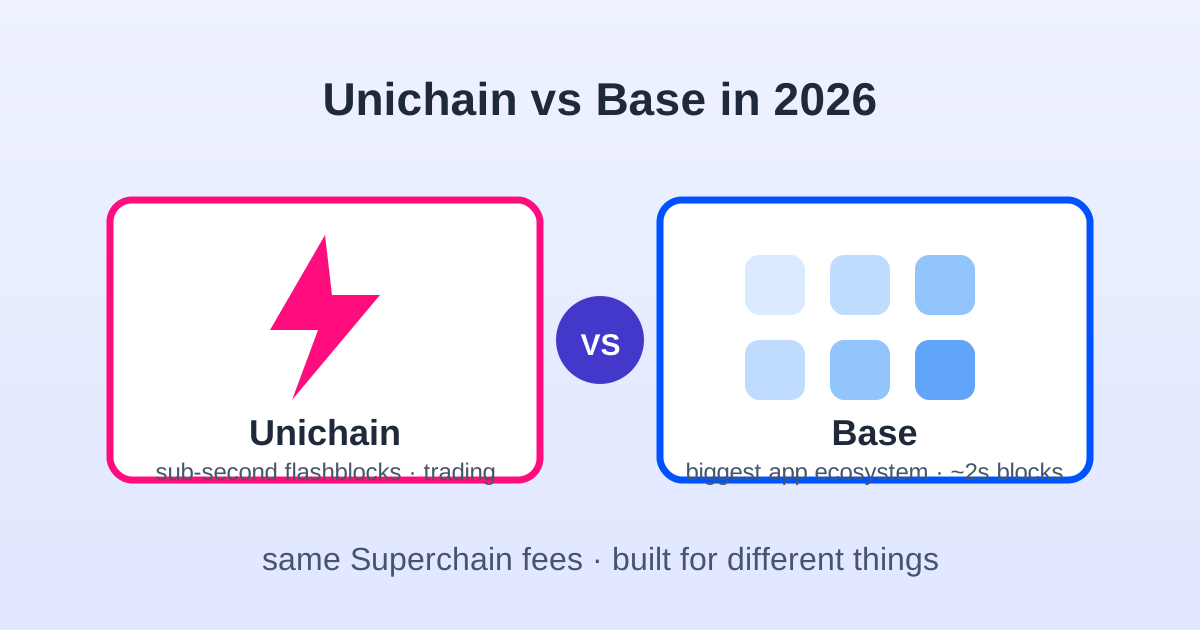
The short version: the fees are effectively the same because the architecture is the same, but the chains do not feel alike to use. One optimized hard for trading latency; the other is the busiest consumer chain in the ecosystem. The background on both is in the Unichain explainer and the Base explainer; this article is the practical comparison from actual receipts.
What the two chains have in common
Both are optimistic rollups built on the OP Stack inside the Superchain. That means the same fee formula — a tiny L2 execution fee plus an L1 data fee paid to Ethereum — the same canonical bridge contracts, the same 7-day challenge window for official withdrawals, and the same chain-add flow in your wallet. Both settle in ETH for gas, both post blobs to mainnet, and both inherited the fee collapse from EIP-4844 described in the blob pricing guide.
Consequence: choosing between them on gas alone is a waste of time. On a quiet day both charge sub-cent transfers, and a $0.002 vs $0.003 swap difference is below the noise of which pool has better liquidity that hour. The Unichain fee breakdown and the Base fee guide show the same band in different fonts. What differs is what the chains were tuned for.
The numbers from my month of receipts
| Metric | Unichain | Base |
|---|---|---|
| Block time feel | Sub-second with flashblocks | ~2 seconds per block |
| Simple ETH transfer | $0.0002-0.001 | $0.0003-0.001 |
| Token swap | $0.002-0.01 | $0.003-0.02 |
| LP / liquidity action | $0.01-0.04 | $0.01-0.05 |
| Depth on major pairs | Good on Uniswap-native pairs | Deepest on the Superchain |
| Non-trading app count | Small and growing | Largest consumer catalog in L2 |
The latency difference is the one you feel rather than measure. On Base, a swap follows the familiar rhythm: click, wallet popup, confirm, a beat, done. On Unichain the confirmation often arrives before the popup animation finishes — flashblocks batch and pre-confirm transactions so aggressively that rapid trades chain together without the two-second wait. For scalping or rebalancing across pools it is genuinely nicer. For one swap a week it is invisible.
Where Unichain actually wins
Trading, trading, trading. The chain was designed around the swap use case: faster block propagation, MEV protection integrated at the protocol level for routed trades, and first-class integration with Uniswap's router and intent-based systems. If your session is a sequence of swaps — entering and exiting positions, chasing a new token, arbing small pool differences — every saved second and every protected fill adds up.
It also wins for pure simplicity of purpose. The app catalog is mostly trading-adjacent, so there is less noise: fewer fake mints, fewer social-app airdrop lures, fewer wallet-drainer campaigns riding a viral consumer app. That sounds minor until you have spent a week on a chain where every trending link is a contract you have to vet.
Where Base wins, decisively
Everything that is not a swap. Base has the deepest liquidity, the most onramps and offramps (nearly every exchange supports Base withdrawals — see the exchange withdrawal guide), the largest lending and stablecoin ecosystem, and the long tail of social, gaming, identity, and payments apps that make a chain feel like a place rather than an order book.
During my month, every time my activity wandered outside trading — supplying stablecoins, claiming an airdrop from a non-DEX protocol, paying someone for a service, minting something — I ended up back on Base. The route was simple: bridge across in a minute for a tenth of a percent, do the thing, bridge back. The Unichain bridge guide documents the Superchain transfer; because both chains share the messaging layer, it is the cheapest cross-chain hop I use regularly.
The ecosystem reality in one paragraph
Picking a chain partly means betting on where builders deploy. Base currently wins the breadth bet by a wide margin: it is where consumer apps launch first, where Coinbase pushes its 100-million-account user base, and where the most stablecoin velocity sits. Unichain wins the trading-infrastructure bet — anything involving swaps, intents, and order flow gets first-class treatment there, and integrations with professional routing systems keep improving.
The good news is this is not a lock-in decision. The Superchain was designed precisely so that picking one today costs almost nothing to reverse tomorrow. My settled setup: trading float on Unichain when I am actively trading that week; everything else — savings, DeFi positions, payments, app experiments — on Base. A single wallet, one tiny bridge hop between them.
My recommendation for different readers
If you have read this far and just want the rule of thumb:
- Most people should stay on Base. One chain to manage, deepest pools, direct exchange ramps, the app you actually want is probably already there. Adding a second chain to save a millisecond on your weekly swap is fake optimization.
- Active traders should try Unichain. If you measure your day in dozens of swaps, the latency and MEV design are real quality-of-life upgrades. Move over a trading float, not your whole portfolio.
- DeFi yield users stay on Base for now. Lending markets, vaults, and liquidity incentives remain deeper there. Revisit as Unichain's catalog grows — these things change quarter to quarter.
For the broader "which cheap chain is cheapest" question the cheapest L2 ranking puts both in the same tier, and honestly, that is the correct answer: the difference is never the gas. It is what you are trying to do, and what each chain was built to do well.
Trade on Base / Arbitrum with Low Fees
Choose a trusted platform to swap, bridge, and trade on L2 networks.
Affiliate links — we may earn a commission at no extra cost to you.