Uniswap Slippage Tolerance: The Exact Settings I Use on Base and Arbitrum
The failed swap that taught me the setting exists
My first month on Uniswap, one in every five swaps failed with an error I did not read: "TransferHelper: TRANSFER_FROM_FAILED" or "Too little received." I would click again, it would fail again, and I would assume the chain was broken. The chain was fine. My slippage tolerance was sitting at the default, and the market price was moving more than the tolerance allowed between my click and my inclusion.
Then I watched the reverse problem happen to a friend: he cranked tolerance to 20% to force a stubborn trade through, and a token with predatory tokenomics ate the difference. Same setting, opposite disaster. Slippage tolerance is a single number that fails in both directions, and on cheap, fast L2s people treat it carelessly because the gas cost of failure is only a penny. This is what I wish someone had explained.
Three different things that share one quote screen
When Uniswap shows "1 ETH = 3,200 USDC" and you receive 3,168, the gap can come from three different places:
- Price impact is deterministic: your trade moves the pool, and a larger order against a shallower pool gets a worse price. It is shown before you sign, and no setting makes it disappear — only smaller trades or deeper pools fix it.
- The fee is the protocol/liquidity cut, separate from both. The Uniswap fee guide breaks down the tier numbers.
- Slippage is the unknown part: how far the execution price is allowed to drift from the quoted price between signing and inclusion, because of market movement or reordering.
Your tolerance setting only controls number three. If price impact alone already makes the trade look bad, raising tolerance does not improve it — it just guarantees you accept whatever happens next.
The settings I actually use
| Trade type | My tolerance | Why |
|---|---|---|
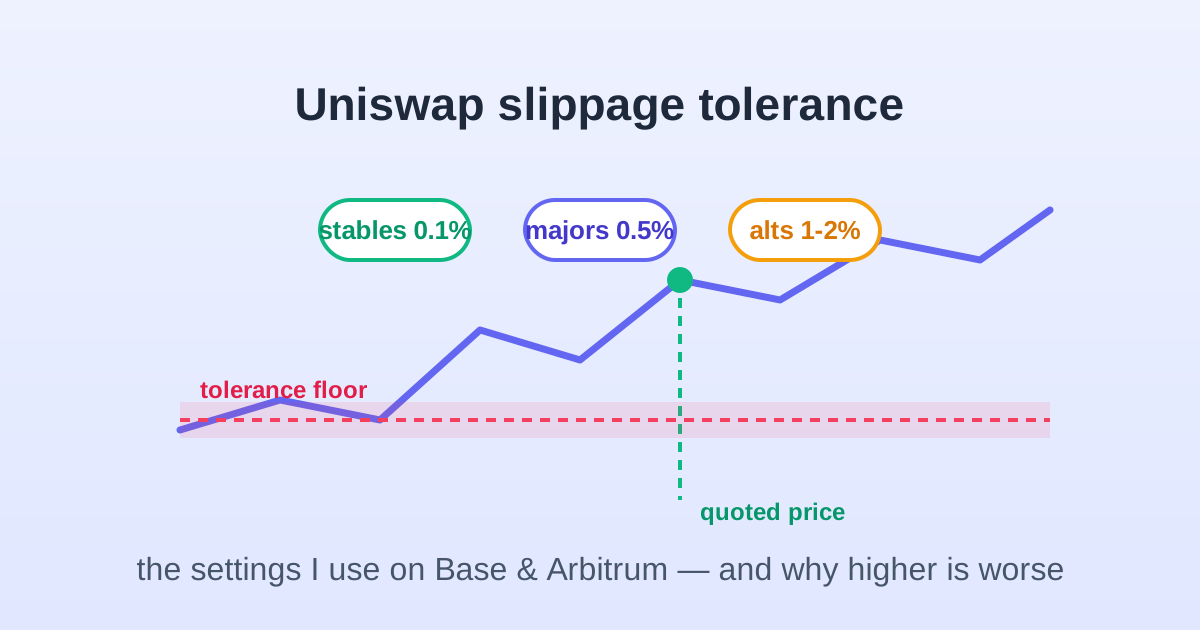
| Stablecoin pairs (USDC/USDT) | 0.1% | Pegged pairs barely move; anything worse signals a pool problem |
| Majors (ETH, WBTC) | 0.5-1% | Default territory; covers normal movement in fast L2 blocks |
| Altcoins / mid-cap | 1-2% | Wider spreads and thinner pools; only raise when needed |
| Newly launched / volatile | 3% max, then trade small | Above this you are inviting exploitation, not fixing failure |
| Limit orders / protected routing | Minimal or auto | The order does not fill unless the price meets it |
On Base and Arbitrum specifically, I run slightly tighter tolerances than I used to on mainnet. L2 blocks confirm in seconds, so there is far less time for the market to move between quote and fill — the exact reason defaults fail less often here. When a swap does fail with a slippage error, I re-quote and retry at 0.5% before I ever touch the custom box. Two retries with fresh quotes beat one panicked tolerance hike every time. Failed transactions only cost pennies on these chains; accepted bad fills cost real money.
Why raising tolerance is the expensive direction
Tolerance is not a difficulty setting where higher guarantees success. It is permission — you are signing "this transaction may execute at any price up to this much worse than I was quoted." On a healthy token in a standard pool, nobody can use that headroom because competition keeps fills near the market price. On a token with hidden mechanics — fees-on-transfer, pausable transfers, or a low-liquidity pool dominated by one player — that headroom becomes the exact amount the trade can be made worse by.
The classic exploit shape is a sandwich: your generous tolerance allows execution after the pool has been pushed against you, then it snaps back and someone keeps the difference. Sandwiches are much harder on modern L2 routing than they were on mainnet historically, because sequencer ordering and protected routing remove most of the simple versions — but they are not magic against self-inflicted tolerance. You cannot be sandwiched below your tolerance; you can always be made worse up to it.
Getting failed transactions instead
Too tight produces the opposite frustration: "minimum received not met," reverted swaps, gas spent on nothing. On Base or Arbitrum that gas is $0.003-0.02, annoying but harmless. Work through it in order: refresh the quote first (stale quotes after sitting on a wallet popup are the number-one cause), then check whether you are trading through a shallow pool where impact itself exceeds your setting, then bump tolerance by half a percent and retry once.
If failures continue at reasonable tolerances, the problem is usually the token, not your settings — I have seen fee-on-transfer memecoins where every Uniswap trade reverts at default because the token contract skims on every move. That is the token telling you what it is. The failed transaction guide covers the full diagnostic flow, including the non-slippage causes (approvals, gas, expired quotes) that masquerade as slippage errors.
Two habits that make the setting irrelevant
The better versions of this workflow avoid guessing altogether:
- Split large trades. A $20,000 swap against a thin pool is a price-impact problem no tolerance fixes. I break trades above roughly 1% of a pool's daily volume into pieces across ten minutes. Each piece quotes better, and the average fill beats one fat trade even ignoring the risk.
- Use limit orders for price-sensitive trades. Most modern Uniswap front-ends and routing systems offer limit or Dutch-auction style orders that wait for your price rather than accepting a range. I use them whenever I am not in a hurry — zero slippage anxiety by design, and fills sometimes beat the spot quote.
And the boring hygiene: verify the token contract on the explorer before trading anything new (the Arbiscan guide shows how), and never paste a tolerance suggested by a token's website or Telegram group. "Set slippage to 15% to buy" is not a technical instruction — it is a confession about what their contract does to buyers.
The one-paragraph version
0.1% for stables, 0.5-1% for majors, 1-2% for volatile alts, never above 3% on Base or Arbitrum, and when a swap fails, refresh and retry before loosening anything. Remember that tolerance is permission for a worse price, not a success slider — and that the cheapest L2 fees in the world do not compensate for accepting a fill you explicitly authorized. With those defaults in my wallet, my failed-swap rate dropped and my bad-fill stories stopped entirely.
Trade on Base / Arbitrum with Low Fees
Choose a trusted platform to swap, bridge, and trade on L2 networks.
Affiliate links — we may earn a commission at no extra cost to you.