Are Layer 2 Transactions Taxable? What I Learned Sorting 400+ Base Transactions
The export that made me wince
At year-end I exported my on-chain activity and stared at more than four hundred rows tagged Base, plus another hundred-something on Arbitrum. Swaps, approvals, bridge exits, a failed mint, three airdrop claims, gas paid in ETH on every single row. I had spent the year enjoying sub-cent fees without once thinking about what they meant for reporting. Then I booked a session with an accountant who actually works with crypto clients, dumped the spreadsheets on her desk, and started asking stupid questions.
The core finding was almost relaxing: being on a Layer 2 changes the amounts, not the rules. A trade is a trade whether it settles on mainnet for $18 of gas or on Base for $0.003. What actually matters is the type of event — swap, transfer, reward, fee — and the records you can produce. Here is the framework from that session, applied to the things L2 users actually do every day. Nothing here is formal tax advice; rules vary by country and change, and a real professional who knows your jurisdiction is worth the fee.
What counts as a taxable event on Base or Arbitrum
The short version my accountant gave me: you are taxed when you dispose of crypto or receive it as income. Which chain recorded it is irrelevant to that classification.
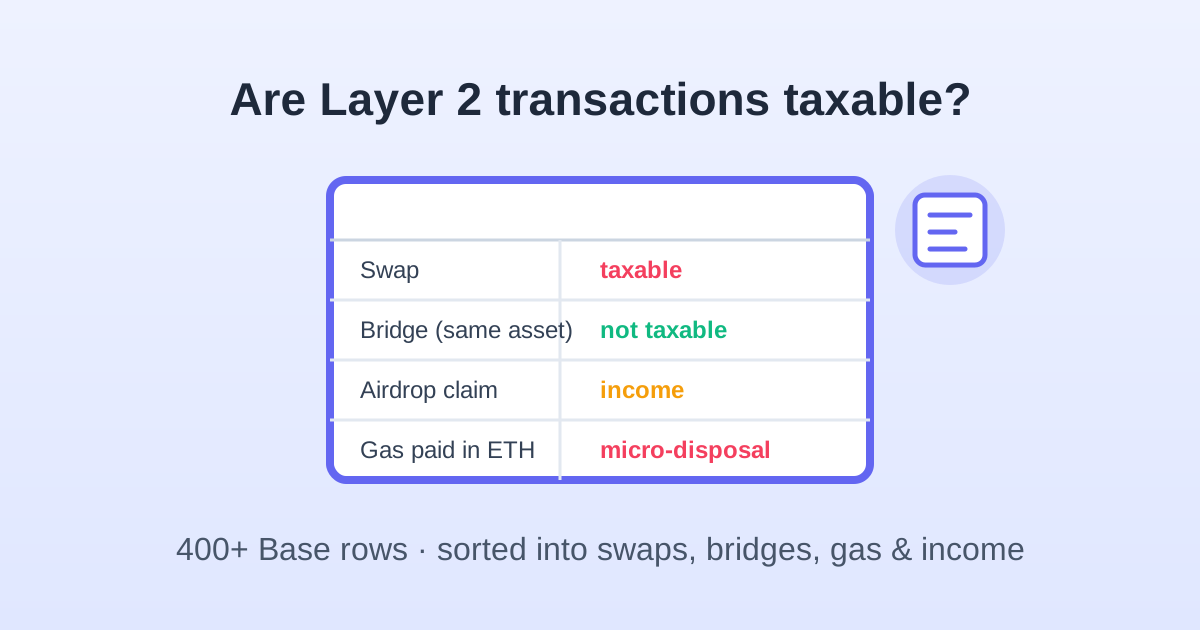
| L2 activity | Typical treatment | Why |
|---|---|---|
| Token-to-token swap | Taxable disposal | You sold one asset and bought another; gain/loss on the sold side |
| Paying gas in ETH | Technically a disposal | Each fee spends ETH at a cost basis; amounts are usually tiny |
| Official bridge L1↔L2 | Usually not taxable | Same asset, same wallet, no disposal — a location change |
| Moving between your own wallets | Not taxable | But document sender and recipient addresses |
| Airdrop claim | Income at claim value | Taxable when received; later sale is a second capital event |
| Staking/LST rewards | Often income on receipt | Jurisdiction-dependent; see staking guide below |
| Failed/reverted transaction | Nothing disposed | No transfer occurred; gas may still be lost |
The gas-in-ETH row is the one nobody expects. Every transaction technically disposes of a sliver of ETH, which can carry a capital gain or loss versus your cost basis. On Base that sliver is $0.001, times four hundred transactions — real line items, immaterial amounts. My accountant's practical advice was to let software aggregate gas spend rather than hand-compute four hundred micro-disposals, and to keep the methodology consistent year over year.
Bridging: usually not taxable, with two footnotes
Moving ETH from mainnet to Base, or USDC from Arbitrum to Base, is generally not a taxable event: you still own the same asset, in the same proportion, just on a different network operated by your same wallet. The seven-day official bridge wait changes nothing about this; neither does paying a fast bridge for speed. The withdrawal time explainer covers why the delay exists — it is a security window, not a sale.
The two footnotes:
- Wrapped-token hops. If your "bridge" actually swaps native USDC into a different token — USDC to USDC.e, ETH to WETH to a third representation — the conservative reading treats each token change as a disposal. The CCTP guide explains why I burn-and-mint native USDC instead; avoiding wrapper swaps keeps both the asset and the accounting clean.
- Bridge fees paid in-kind. A fee taken as a slice of the transferred asset can be logged as a disposal equal to the fee. Percentage fees of 0.1% create rounding-error numbers, but they belong in the export.
The two income categories L2 users forget
Airdrops are income on the day you claim them, valued at market price that day — even if you never sell and the token later goes to zero. When you eventually sell, you calculate a second event: capital gain or loss from the claim-day value to the sale price. A token that crashes to nothing after you claim still leaves you with income tax on a value you never realized in cash, which is the specific pain of farming season. Cost, claim date, claim-day price, sale date — all four go in one row. The farming side, including realistic qualification costs, is in the Base airdrop guide.
Staking and liquid staking rewards — stETH, rETH balances and their rebase or exchange-rate accrual — are treated as income in many jurisdictions when the reward is received or becomes accessible, again at market value. Because you cannot run a validator from a rollup, L2 users mostly encounter these as liquid staking tokens bridged in or swapped; the mechanics and cost basis nuances are in the L2 staking guide.
The cheap fees are a tax trap in disguise, by the way. On mainnet, high gas naturally limited how many micro-transactions people made. On Base I swapped ten times in an evening for the price of a single mainnet trade — and every swap is a disposal with a cost basis to track. The chain enabled the behavior; the reporting obligation came along for the ride.
The record-keeping system that survived review
My setup after that accountant session is nothing fancy, but it closes the gaps that pure auto-import misses:
- One label per wallet. My hot wallet, Ledger address, exchange accounts, and the two throwaway farming wallets each have a name in a spreadsheet. Transfers between labeled self-wallets are provably non-taxable instead of looking like income.
- CSV exports from every explorer. Basescan and Arbiscan both export full transaction and token history per address. I keep the raw CSVs alongside any aggregator tool's output — when the tool mislabels a bridge as a swap, the explorer log settles it.
- Manual notes for the weird rows. Airdrop claims, contract approvals that should show zero value, the one failed mint, and anything involving a token the price API does not recognize get a one-line note at the time, when I still remember what happened.
- A cost-basis method, chosen once. FIFO, specific identification, or whatever your jurisdiction allows — pick it and keep it. Re-choosing the favorable method per transaction is exactly what audits penalize.
- Quarterly reconciliation, not January panic. Thirty minutes every quarter, same cadence as my approval cleanup. Four hundred rows sorted in four sessions is trivial; sorted once on deadline night is a nightmare.
If your volume is genuinely high — dozens of trades a week, multiple chains, DeFi positions — crypto-specific tax software that ingests wallet addresses via public explorer data is where most people land. The category handles L2 chains reasonably well now; the manual work concentrates in the same weird rows (airdrops, wrappers, self-transfers) no matter which tool you pick.
The three takeaways I would give past-me
One: chain choice is a cost decision, not a tax category. Base, Arbitrum, and mainnet apply the same gain, income, and transfer logic; only the gas numbers differ. Two: bridges and self-transfers are mostly non-events, while swaps, claims, and reward receipts are events — and the cleanest way to avoid gray-area wrapper disposals is to hold canonical assets through mechanisms like CCTP. Three: on a chain where you transact four hundred times a year, labeling wallets and keeping notes while the transactions are fresh matters more than any clever end-of-year maneuver.
If any of the numbers in this article describe real money of yours, spend the few hundred dollars on a one-time professional review of your actual history. That session cost me less than one mainnet bridge used to, and it converted "I hope this is right" into a documented, defensible system before the next cheap, busy year on L2s.
Trade on Base / Arbitrum with Low Fees
Choose a trusted platform to swap, bridge, and trade on L2 networks.
Affiliate links — we may earn a commission at no extra cost to you.