Sent Crypto to the Wrong Network? How I Recovered Funds Sent Between Base and Arbitrum
My $1,200 moment of panic
I was moving USDC off an exchange to pay for something on Base. I pasted my address, hit withdraw, and watched the confirmation screen settle on "Network: Arbitrum One." Wrong chain. I had selected Arbitrum from muscle memory three screens earlier. $1,200, gone into a network I did not have open, to an address I hoped was actually mine.
It took me about four minutes to confirm the money was fine, and about three minutes more to move it where I wanted. The second time I sent to the wrong network — a friend's case, really, with an exchange deposit address — it took nine days and a $50 recovery fee. Same broad mistake, completely different outcomes. The difference is where the receiving address lives, and that is the first thing to figure out before you touch anything.
The one fact that calms everyone down
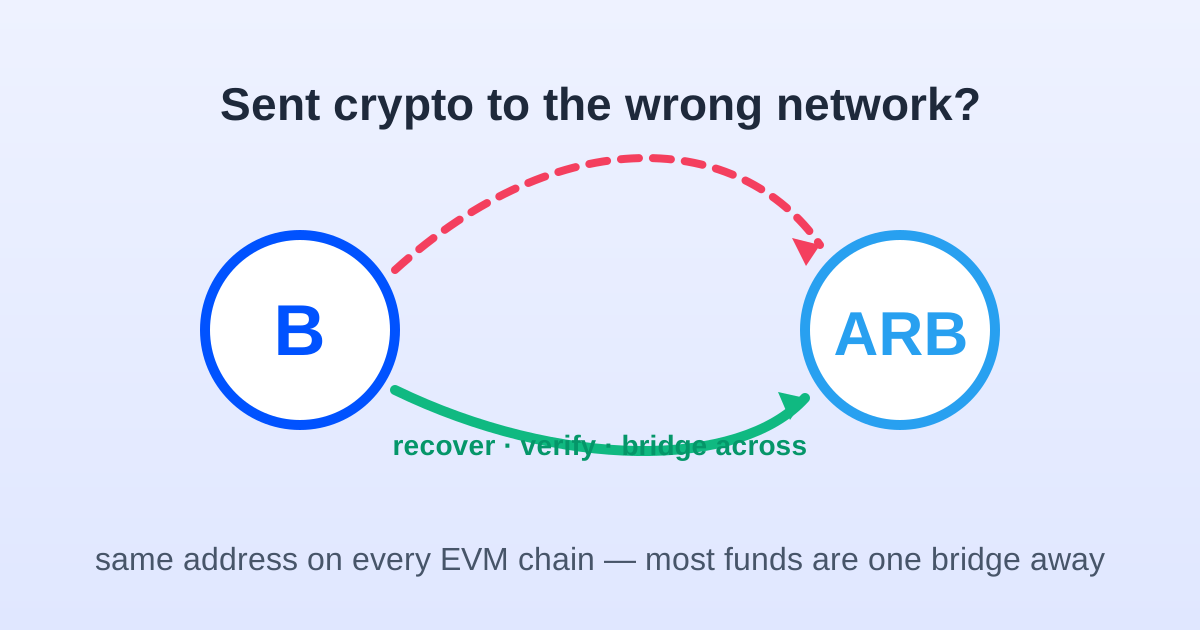
Base, Arbitrum, Optimism, and Ethereum mainnet are all EVM chains. Your wallet does not have a separate address per chain — the same private key controls the same 0x address on every one of them. When an exchange says it sent your USDC "on Arbitrum," the tokens are not floating in limbo and they did not go to a stranger. They are sitting at your same address on the Arbitrum network. You just cannot see them while your wallet is switched to Base.
Step zero in any wrong-network panic: add the destination network to your wallet, switch to it, and look. Most of the time the balance is right there. If the network is not in your network list yet, the Base MetaMask guide and Arbitrum MetaMask guide cover adding them, or use chainlist.org with one click.
Confirm on the explorer, not the wallet UI — paste your address into Arbiscan or Basescan, open the token holdings tab, and the chain that actually holds the tokens is the ground truth. The Basescan guide shows exactly where to look.
Which of the four cases are you in
Recovery difficulty depends entirely on the receiving address. I have sorted every wrong-network story I have seen into four buckets:
| Case | Typical situation | Recovery | Cost |
|---|---|---|---|
| A. Your own wallet address | Exchange withdrawal or send went to your address on the wrong EVM chain | Trivial — bridge it across yourself | Cents |
| B. Another exchange address you control | Sent to your account on a different exchange that supports that network | Usually self-service | Withdrawal fee |
| C. Exchange deposit address, wrong network | Deposited to an exchange via a network it does not credit for that token | Support ticket; possible, not guaranteed | $0-100+ fee |
| D. Contract address or non-EVM chain | Sent to a token contract, or across to Solana/Bitcoin address format | Often unrecoverable | Total loss risk |
My $1,200 incident was case A — easiest one there is. My friend's was case C, which is the one that actually costs sleep. Identify your bucket before doing anything else, because case C has a clock on it and case D gets worse if you start poking the contract.
Case A: it landed in your own wallet on the wrong chain
This is 90% of the panic messages I get, and it is a non-event once you reframe it. The tokens are yours on the wrong chain; moving them between Base and Arbitrum directly is a normal cross-L2 transfer. Do not route them up to Ethereum mainnet first — that means a 7-day official bridge wait or mainnet-level fees, for no reason.
What I did: opened a fast intent bridge, connected on Arbitrum, selected USDC with Base as the destination, signed one transaction, and received native USDC on Base about three minutes later for under $0.20 all in. The Base to Arbitrum transfer guide walks the reverse trip with the same bridges — Across, Stargate, and Hop all run this pair with deep liquidity. ETH works identically.
One thing to know: you need a little gas token on the chain where the funds actually are. If 200 USDC landed on Arbitrum and you hold zero ETH there, you cannot initiate anything. Buy a few dollars of Arbitrum ETH on an exchange and withdraw it to your same address, or send it from a friend — one bridge transaction needs roughly $0.05 worth.
Case C: wrong network on an exchange deposit
This is the dangerous one. You sent tokens to the exchange's deposit address using a network the exchange does not process for that asset — for example, USDC on Arbitrum to an address where the exchange expects Base USDC, or an EVM withdrawal to a deposit memo system that never sees it. Some exchanges credit these anyway when both networks are supported; many do not.
My friend's recovery worked, and here is what it actually involved. He opened a support ticket within the hour, selected "wrong network/chain deposit," and attached the transaction hash, the sending address, the receiving deposit address, the exact token and amount, and the network used. The exchange asked him to verify identity again, sign a message proving he controlled the sender address, and pay a flat recovery fee of $50 up front. The funds appeared nine days later. Exchanges publish lists of which cross-network mistakes they recover — some charge $20, some $100, and some refuse entirely for contract-managed deposits. Smaller exchanges often have no recovery process at all.
Do not send follow-up transactions "to test," do not message "support" in DMs (the first five replies will be scammers), and do not pay anyone who approaches you offering recovery for crypto up front. The real ticket is free to open; the fee, if any, is deducted through the official exchange interface.
Case D: contract addresses and non-EVM chains
If the receiving address is a contract you found on an explorer rather than a wallet — say you pasted the USDC contract address itself as the destination — the tokens went into the contract's balance with no mechanism to send them back. A few protocols have governance-run recovery for famous mistakes, but assume the funds are gone. Sending EVM-chain assets to a Solana, Bitcoin, or other non-EVM address format is similarly unrecoverable through normal tooling, because the keys do not map across systems.
I include this bucket not to sound grim but because people in this situation are the favorite target of "recovery expert" scammers, who promise to retrieve the funds for an advance fee and then vanish. If it is genuinely case D, the honest answer is that no wallet popup, browser tool, or Twitter expert can reverse a confirmed transaction. No one has that power — that is the property of the system that protects the transactions that go right.
The checklist I run before every withdrawal now
Two mistakes taught me habits cheaper than the tuition:
- Whitelist addresses in the exchange. Every exchange I use has an address book with a 24-48 hour hold on new destinations. The hold is annoying exactly once; after that, fat-fingered and clipboard-manipulated addresses are impossible.
- Match the network badge twice. I check the network on the withdrawal screen, then check it again on the confirmation page where the fee is shown. My $1,200 mistake failed because I only looked once.
- Send a test amount first, for new routes. A $10 probe to a new address or network pair, confirm it lands, then send the real amount. The two extra withdrawal fees cost less than one recovery process — and infinitely less than a total loss.
- Paste, then compare characters. Malware that swaps clipboard addresses exists. I compare the first six and last six characters of the address in the confirmation against what I copied.
- Keep gas money on both chains. A few dollars of ETH on Base and Arbitrum means any case-A rescue never stalls at the one thing I can fix in three minutes.
If you are reading this with an unconfirmed transaction still pending, you may have another option entirely: a pending withdrawal can sometimes be sped up or cancelled at the nonce level before it mines. The pending transaction guide has the steps, and the window is usually only a minute or two on these fast chains.
Trade on Base / Arbitrum with Low Fees
Choose a trusted platform to swap, bridge, and trade on L2 networks.
Affiliate links — we may earn a commission at no extra cost to you.