WETH vs ETH on Base and Arbitrum: Why Uniswap Keeps Asking You to Wrap
Where did my ETH go
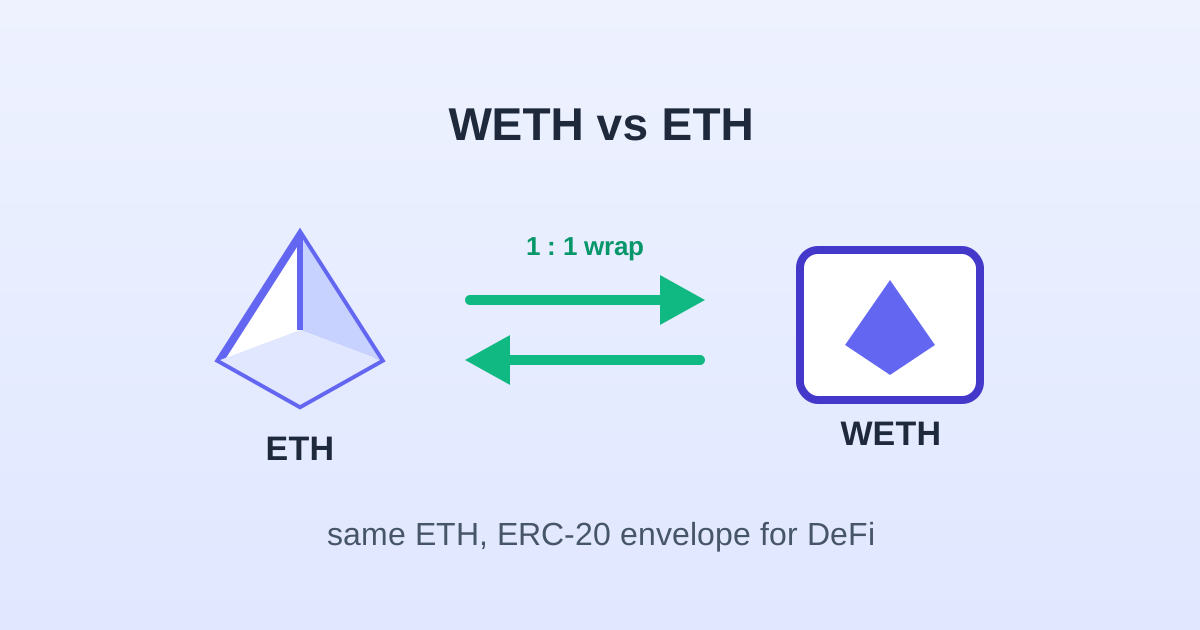
A familiar message lands in my inbox every few weeks: "I swapped on Uniswap and my ETH turned into some WETH token. Did I get scammed?" The short answer is no — almost certainly. You either toggled the wrap option or traded through a route that wrapped your ETH along the way, and WETH is not a competitor coin, a derivative, or an IOU. It is the same ETH wearing a standard interface.
The confusion exists because ETH predates the ERC-20 token standard by a couple of years, and it was never retrofitted. Native ETH moves with its own transaction rules; every other token — USDC, ARB, random memecoins — follows one uniform contract standard. DeFi is built entirely on that standard, so to let ETH participate, someone had to wrap it. This article is what I send people instead of typing the explanation for the tenth time.
What wrapping actually does
The WETH contract is a deliberately simple vault. You send it 1 ETH, it mints 1 WETH to your address and locks the ETH in the contract. When you unwrap, the contract burns the WETH and sends 1 of the locked ETH back. The ratio is permanently 1:1, enforced by the contract code itself rather than by a market price — WETH can never depeg from ETH because every WETH is a claim on a specific ETH sitting in reserve.
It is analogous to putting a coat in a cloakroom and getting a numbered ticket. The ticket is not the coat, but anyone holding the ticket can reclaim the coat, so tickets trade exactly as coats would. WETH is the ticket. On rollups the canonical WETH contracts are even deployed at special protocol-controlled addresses — Base mints and maintains its WETH at 0x4200000000000000000000000000000000000006 as part of the predeploy set, and Arbitrum uses 0x82aF49447D8a07e3bd95BD0d56f35241523fBab1.
ETH vs WETH: the differences that matter
| ETH (native) | WETH (ERC-20) | |
|---|---|---|
| Pays gas | Yes | No — must unwrap first |
| Works in DeFi pools | Only via router wrapping | Natively everywhere |
| Needs token approval | Never | Yes, once per spender |
| Price vs ETH | — | Always 1:1 by design |
| Wrap/unwrap cost on L2 | $0.001-0.02 each side, seconds | |
The gas-payment row is the one that bites. If you swap every wei into WETH, your next transaction will fail with an insufficient-funds error even though your wallet looks loaded — you hold a token the network will not accept as gas. Keep a small slice in native ETH at all times; the sizing math is in how much ETH for L2 gas.
The approval trap right after wrapping
Native ETH needs no permission to move — it is yours. WETH is an ERC-20, so before a protocol can pull it from your wallet, you must sign an approval transaction. That means a typical first DeFi session on Base is: approve the router to spend WETH (cents), then swap (cents), with the wallet throwing two popups that look nearly identical. People who only expect one signature often reject the approval and wonder why the swap then fails.
Approvals are also the biggest security surface in DeFi: an unlimited allowance to a malicious or later-compromised contract lets it drain that token from your wallet at any time. The mechanics of allowances are in the ERC-20 approval fee guide, and the cleanup routine — which costs pennies on L2 — is in revoking token approvals. My rule: approve the exact amount for one-off use, unlimited only for routers I use weekly, and revoke anything else quarterly.
Where wrapping happens without asking
Modern Uniswap-style routers bundle wrapping into the swap. When you trade ETH for a token, the router wraps your ETH in the same transaction; when you sell a token "for ETH," the router receives WETH from the pool and unwraps it before sending native ETH back. That is why some routes instead deliver WETH — certain pools, bridges, and limit-order contracts only speak ERC-20 and skip the final unwrap to save a little gas.
You will also see WETH required directly for NFT markets, lending markets, and LP positions. None of this is a problem as long as you remember two things: keep gas money in native ETH, and unwrap is always available, cheap, and permissionless. You are never locked into WETH.
Fake WETH is the real danger
Because everyone recognizes the WETH logo and ticker, scam tokens clone it constantly. A fake "Wrapped ETH" with the right icon but a different contract address is a classic dust-token and honeypot ingredient. The genuine WETH on each chain has one canonical address — verify anything claiming to be WETH against the chain docs or the explorer token list before trading. On the explorer, the real token carries the official name tag; the explorer vetting process is in the Arbiscan guide and its Basescan counterpart.
Two sanity checks: real WETH never needs a website to tell you to "upgrade" or "claim" it, and real WETH swaps have deep official liquidity. If an unknown WETH variant only trades in a shallow pool on an unfamiliar interface, that is not your WETH position — it is a trap dressed in your WETH position's clothes.
The practical wrap policy I use
- Keep $15-25 of native ETH for gas at all times.
- Wrap only what the next session of DeFi activity needs — wrapping is so cheap on Base and Arbitrum that there is no reason to pre-wrap a stack.
- Unwrap leftovers when leaving a protocol, so a wallet glance tells you the truth.
- Approve sparingly and revoke on a schedule.
- Verify the contract address once per chain, then save the token in your wallet so the real one is always what you see.
That is the whole topic. WETH is not a second currency, a bet, or a risk in itself — it is an adapter. The risks worth your attention are the approvals and the impostors, not the wrapping, which on a good L2 costs less than the price of typing the question about it.
Trade on Base / Arbitrum with Low Fees
Choose a trusted platform to swap, bridge, and trade on L2 networks.
Affiliate links — we may earn a commission at no extra cost to you.