Fusaka Explained: Why Base and Arbitrum Fees Got Cheaper Again in 2026
Three upgrades, one long collapse
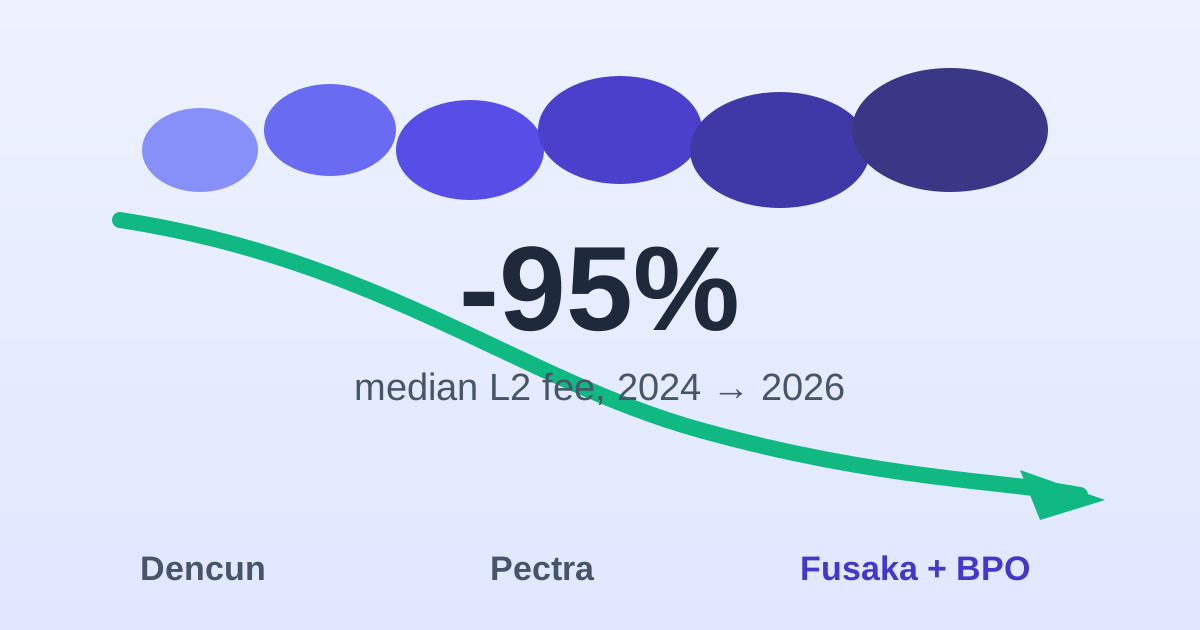
If you checked L2 fees a year ago and again today, the drop looks like a glitch. It isn't — it's the third act of a sequence. Dencun introduced blob space in March 2024 and cut L2 fees roughly 95% overnight. Pectra doubled blob capacity in May 2025. Then Fusaka shipped on December 3, 2025 and, through its PeerDAS design plus two parameter bumps that followed in December and January, knocked fees down again — typical swaps that ran $0.05 to $0.15 in mid-2025 now settle around $0.002 to $0.02, and independent tracking puts the median fee across the big three L2s at roughly $0.0015 in early 2026, down from about five cents two years earlier.
This post is the sequel to my EIP-4844 explainer — that one covers why blobs exist. This one covers what Fusaka changed, what you notice (or don't) when you swap on Base today, and what's scheduled next. Short version for the impatient: fees went down, spikes got rarer and smaller, and the trend is still downward.
What Fusaka actually changed: PeerDAS, in plain English
Remember what blobs are: packages of compressed L2 transaction data that rollups like Base and Arbitrum post to Ethereum. Before Fusaka, every Ethereum node had to download and hold every blob. That made scaling blobs dangerous — more blobs meant heavier hardware requirements, which eventually threatens decentralization. So blob capacity sat capped at 6 target / 9 max per block, and when L2 demand pushed against that ceiling, blob fees spiked and your swap got pricier.
PeerDAS (Peer Data Availability Sampling, EIP-7594) breaks that trade-off. Each node now stores only about one-eighth of the blob data, using erasure coding — a mathematical trick where the data is expanded with redundancy so any missing piece can be rebuilt from the pieces that exist. Nodes spot-check each other to confirm everything is available. The security math holds (the chance of data silently disappearing is something like 1 in 10^20), while node workloads actually dropped — validator bandwidth requirements fell by most of a double-digit percentage after the fork. The headline: blob capacity can now scale roughly 8x without asking node operators to buy better computers.
The BPO forks: the dial that keeps turning
Fusaka also shipped a genuinely new mechanism: Blob Parameter Only forks (EIP-7892). Instead of waiting years for a named upgrade to raise blob counts, developers can now turn that one dial through a lightweight fork on its own schedule. Two went live right after Fusaka:
- BPO1 — December 9, 2025: target blobs 6 → 10, max 9 → 15
- BPO2 — January 7, 2026: target 14, max 21
Two bumps in a month — that pace was simply impossible under the old upgrade model. Each blob holds 128 KB, so capacity went from roughly 768 KB to about 2.7 MB of data per block in five weeks. More capacity means the blob fee market rarely gets tight, which is exactly why L2 fees stepped down again in January and have stayed flat since. My statistics page keeps the benchmark table current if you want the numbers behind this.
What it means when you swap on Base today
Your fee on an L2 has always been two bills: L2 execution (fractions of a cent, set on the L2) and the data fee (your slice of the blob bill). Fusaka's changes attack the second bill, which was the bigger one. Practical effect in 2026: a plain token transfer on Base is often literally under a cent, a Uniswap swap runs $0.002 to $0.02, and the panic-spike behavior — where an NFT mint on some other chain doubled your morning's transaction costs — has mostly stopped happening at meaningful scale.
Arbitrum users see the same relief, with one legacy quirk intact: Arbitrum's fee calculation still tracks mainnet conditions more visibly than Base's, so during rare Ethereum congestion weeks, Arbitrum fees wobble more (the Arbitrum explainer has the mechanism). Both chains, though, are now firmly in "check if you're curious, not because you're scared" territory. The Base calculator and Arbitrum calculator show today's numbers.
When fees can still jump (yes, it can happen)
Honesty section. Three scenarios can still push your fee up: a genuine demand surge on Ethereum mainnet raising gwei (your L2 fee follows — this is the mainnet relationship and it isn't going away); a burst of L2 activity squeezing blob space between BPO bumps — the parameters are only raised periodically, so a viral mint can temporarily spike blob fees until the next bump; and congestion on the L2's own sequencer, which shows up as slower confirmations more than higher prices. All three now produce spikes measured in cents, where the same events in 2023 produced dollar figures.
The habit that still pays: glance at the live tracker before large or time-sensitive transactions. Not because fees are dangerous anymore, but because "normal" is the number you compare against when a wallet quote looks off.
What's next: more BPOs, Glamsterdam, sub-cent everything
The roadmap keeps pointing the same direction. More BPO forks are planned through 2026 and 2027, with the long-run target of 128 blobs per block — capacity that would put L2 fees solidly in the sub-$0.001 range and make micropayments-grade economics routine. The next named upgrade, Glamsterdam, brings ePBS (enshrined proposer-builder separation), which restructures how blocks get built and sets up further scaling after that. Dates for named upgrades stay fuzzy by nature; BPO bumps are the reliable drumbeat to watch.
For you, practically: nothing to do and nothing to change. Keep a few dollars of ETH for gas the same as always (the buffer math hasn't moved — smaller fees just mean it lasts even longer), bridge or withdraw from exchanges on any ordinary day instead of timing the market, and enjoy the fact that the single most annoying cost in crypto quietly became a rounding error. If you want the full arc in one place — Dencun to Fusaka — that's the blob story from the beginning.
Trade on Base / Arbitrum with Low Fees
Choose a trusted platform to swap, bridge, and trade on L2 networks.
Affiliate links — we may earn a commission at no extra cost to you.