Coinbase Wallet vs MetaMask on Base in 2026: Fees, Security, and Which One I Actually Use
The short version if you are in a hurry
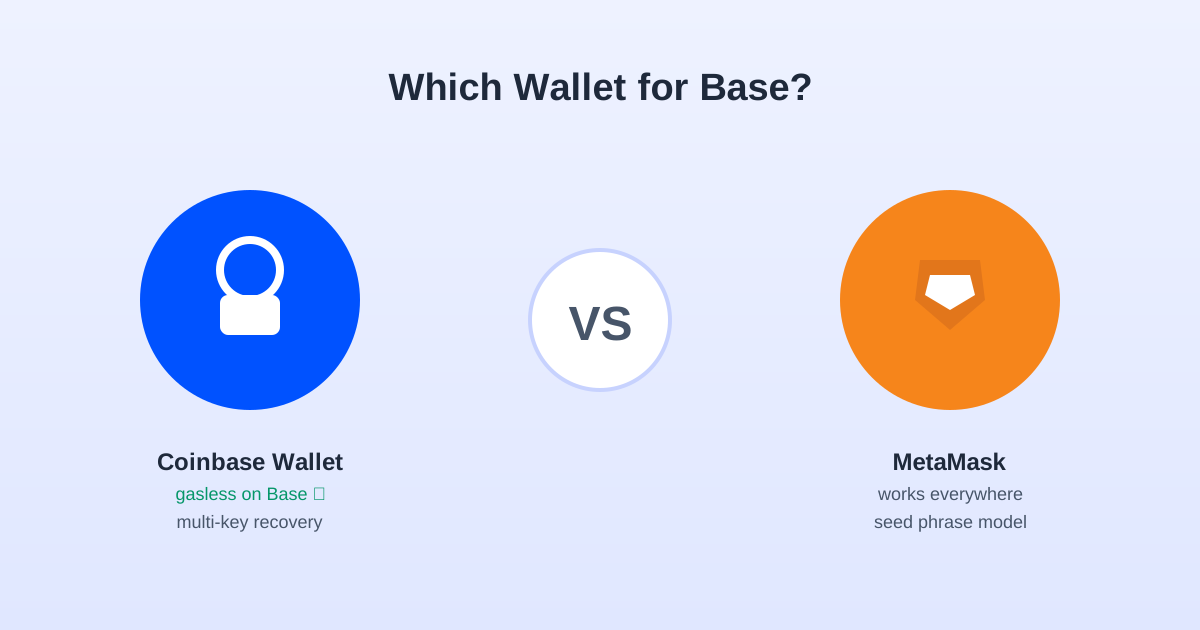
MetaMask is the default EVM wallet that everyone has, everyone supports, and that works with everything. Coinbase Wallet is the one that, on Base specifically, can be nearly gasless thanks to Smart Wallet (ERC-4337) features. If you are on Base and Coinbase-adjacent, Coinbase Wallet is the better experience. If you are on Arbitrum, Optimism, or jumping between many chains, MetaMask is more flexible. I use both, for different things.
If you already know which you want and just need the network setup: MetaMask Base setup and MetaMask Arbitrum setup cover the network-add steps. This article is the wallet-level comparison those guides do not get into.
Fees: the part where the difference is real
On Base, Coinbase Wallet can sponsor gas through its Smart Wallet / paymaster infrastructure. In practical terms: on many Base dApps and Coinbase-integrated routes, you can transact without holding ETH for gas. The wallet uses ERC-4337 account abstraction to let a paymaster cover the gas fee, which the user does not pay (the dApp or Coinbase subsidizes it). This is the feature the gasless transactions guide covers in depth.
MetaMask has no native gas sponsorship. You need ETH in your wallet for every transaction, full stop. On Base this is a $5-10 buffer that lasts for months — not a hardship — but it is a barrier the Coinbase Wallet sidesteps entirely. MetaMask does offer "Smart Transactions" (STX) on some networks, which optimizes gas bidding, but that is a gas-pricing feature, not a gas-sponsoring one.
For swaps, MetaMask routes through its own swap aggregator, which charges a 0.875% fee on top of the DEX spread. Coinbase Wallet also has a built-in swap, and on Base the fee is similar in structure. For large swaps, both wallets' built-in aggregators are more expensive than going directly to Uniswap or Aerodrome — the Uniswap fee guide shows the direct-DEX cost, which is lower.
Security and recovery: two genuinely different models
This is where the two wallets diverge architecturally, and it matters:
| Feature | MetaMask | Coinbase Wallet |
|---|---|---|
| Account type | EOA (externally owned account) | Smart contract account (ERC-4337) |
| Recovery | 12-word seed phrase (or SRP via vault) | Multi-key: cloud backup + device key + recovery key |
| Seed phrase exposure | Must write down and never share; lost phrase = lost funds | No single seed phrase; cloud + device + recovery key share |
| Account portability | Any EVM wallet can import the seed phrase | Smart account address is portable to other 4337-compatible wallets |
| Custody | Self-custody (you hold keys) | Self-custody (you hold keys; Coinbase does not custody funds) |
The key difference: MetaMask's security model centers on the seed phrase. If you lose it, you lose everything. If someone gets it, they take everything. Coinbase Wallet uses a multi-key model where no single key compromise is fatal — the cloud backup (stored with the passkey on your device), the device key, and a recovery key you write down each play a role. Losing one does not lock you out; an attacker getting one cannot drain you.
This is genuinely better for newcomers. The "write down 12 words and never lose them and never let anyone see them" model is a lot of pressure, and the industry has lost plenty of users to seed phrase mishandling. Coinbase Wallet's model trades some complexity (you do need to set up the recovery flow) for a much gentler failure mode.
DeFi and dApp access
MetaMask is the industry default. Every dApp, every DEX, every NFT marketplace supports WalletConnect and MetaMask injection. You will never find a working Base dApp that does not accept MetaMask. Coinbase Wallet is also widely supported (it injects as Coinbase Wallet and supports WalletConnect), but there are occasional edge cases on smaller dApps that only test against MetaMask.
On Base specifically, the major dApps — Aave, Uniswap, Aerodrome, and most others — support both wallets equally well. The Aave on Base guide works identically from either wallet. The difference is convenience, not access.
One thing MetaMask has that Coinbase Wallet does not: a browser extension that works on desktop. Coinbase Wallet is primarily a mobile app (with a browser-in-app), while MetaMask has both a mobile app and a desktop extension. If you do most of your DeFi on desktop, MetaMask is more convenient. If you are mobile-first, Coinbase Wallet's mobile experience is arguably smoother.
Multi-chain: jumping between Base, Arbitrum, and mainnet
MetaMask handles multi-chain natively — you add networks (the Base guide and Arbitrum guide show how), switch between them with the network dropdown, and every dApp sees the right chain. It is the standard EVM experience.
Coinbase Wallet also supports multiple networks, and it auto-detects Base particularly well — you often do not need to add the network manually, it is pre-configured. For moving between Base and Arbitrum without touching mainnet, the L2-to-L2 guide works from either wallet.
My actual setup, and what I recommend
I use MetaMask for desktop DeFi work — it is the extension every dApp tests against, and I never have "this dApp does not support my wallet" moments. I keep my main positions there. I use Coinbase Wallet on mobile for Base payments and gasless sends — the sponsored-gas feature means I can send USDC to someone without checking my ETH balance first, and the biometric unlock is faster than typing a password.
For someone just starting on Base who does not have an opinion: if you are coming through Coinbase (exchange account, already in their ecosystem), Coinbase Wallet is the smoother landing — the gasless feature and the no-seed-phrase recovery model genuinely help. If you are a DeFi regular who is already comfortable with MetaMask on other chains, just add Base to your existing MetaMask — there is no reason to switch wallets for one more chain.
Either way, before your first real transaction, check the live gas tracker so the sub-cent fee you see is the fee you actually pay. And if a transaction gets stuck — which is rare on L2 but does happen — the stuck transaction guide works the same from either wallet, because the nonce replacement method is a chain-level trick, not a wallet feature.
Trade on Base / Arbitrum with Low Fees
Choose a trusted platform to swap, bridge, and trade on L2 networks.
Affiliate links — we may earn a commission at no extra cost to you.