Best RPC Endpoints for Base and Arbitrum in 2026: Fixing Stuck Balances and Slow MetaMask
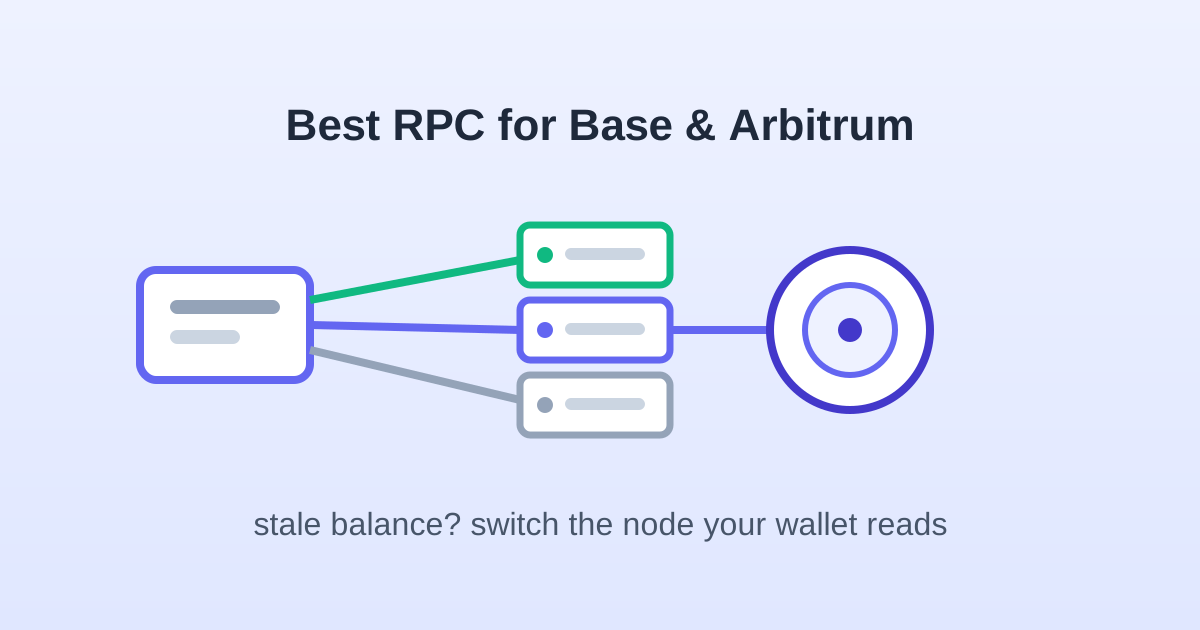
The day my wallet lied to me for three hours
Last year I opened my wallet after a bridge and the balance showed zero. I could see the funds on the explorer, confirmed and sitting at my address, but MetaMask insisted I was broke. Transactions I had sent minutes earlier appeared permanently pending. I wasted an hour assuming the bridge was broken, then switched the RPC endpoint out of idle curiosity. The balance appeared instantly. The pending transactions were already confirmed. Nothing had been wrong with the chain or my money — the node my wallet was talking to had simply fallen behind and started rate-limiting me.
That is the quiet truth about wallet problems: a huge share of "stuck," "missing," and "slow" symptoms are RPC problems, and the fix takes two minutes. Your wallet never connects to "Base" or "Arbitrum" as an abstract cloud. It connects to one specific node operator, and that choice is editable.
What an RPC endpoint actually does
An RPC (remote procedure call) endpoint is the server that answers your wallet's questions: what is my balance, what nonce is my next transaction, what is the current gas price, and please broadcast this signed transaction. The node reads the chain on your behalf. If it is behind, you see stale data; if it is overloaded, requests time out; if it rate-limits you, the wallet spins. None of this changes on-chain reality — it is a pair of dirty glasses, not an earthquake.
Default wallet RPCs are shared by millions of users and throttled aggressively during busy periods. Public third-party endpoints exist precisely to spread that load. This site itself fetches gas data through public endpoints with layered fallbacks, because even application backends hit rate limits — the same defensive design applies to a wallet.
The endpoints I use in 2026
| Provider | Base | Arbitrum One | Notes |
|---|---|---|---|
| PublicNode | base.publicnode.com | arbitrum-one.publicnode.com | My default; no key, CORS open, reliable |
| Official | mainnet.base.org | arb1.arbitrum.io/rpc | Can rate-limit datacenter/broad use |
| 1RPC | 1rpc.io/base · 1rpc.io/arb | Privacy-focused routing, good backup | |
| DRPC | lb.drpc.org/?chain=base · ...=arbitrum | Decentralized node pool, free tier | |
| LlamaNodes / dRPC-style | Provider docs | Privacy-oriented; check current URLs | |
| Ankr public | Now requires an API key | Unauthorized errors without registration | |
Prepend https:// to each host above. Always cross-check the exact current URL against the provider's documentation or the chain's official docs before typing it into your wallet — a malicious RPC URL suggested in a forum is a real phishing vector, because a hostile node can feed you fake balances and lure you into signing against a malicious contract. Endpoints do not move your funds, but they control what your wallet displays, so treat the source of the URL with the same skepticism as any link you click.
The symptoms that mean "switch RPC"
- Balance missing or stale while the explorer shows it clearly at your address.
- Transaction shows pending forever in the wallet but "success" on the explorer — the node lost track of your account's nonce.
- Gas estimate spins or estimates infinity, so the wallet cannot populate the fee fields.
- "Internal JSON-RPC error" or rate-limit popups during busy market hours.
- New block time frozen — the last-block indicator in wallet advanced settings stops updating.
Before switching, rule out the genuine on-chain causes: a truly pending transaction (the speed-up guide covers the nonce mechanics), an insufficient native ETH balance for gas, or a wrong network selected. When the explorer and the wallet disagree, the endpoint is the tiebreaker that is usually wrong.
Private RPCs and MEV protection
Beyond reliability, some endpoints offer transaction privacy: they do not expose your pending transaction to a public pool before inclusion, which prevents simple frontrunning. On Base and Arbitrum the centralized sequencer already removes most of the classic public-mempool MEV, so this matters less than on mainnet — the full picture is in the L2 MEV and sandwich guide. For everyday use I do not pay for a private RPC; I keep two free endpoints and switch when one misbehaves.
What I do pay attention to is not mixing endpoint advice with signing advice. A good RPC can never protect you from approving a malicious contract, and a "free premium RPC" that asks for your seed phrase or a signature is always a scam. Endpoints are configured with a URL and a chain ID only. Nothing else.
Cross-checking that the wallet is finally right
After switching, the thirty-second verification: compare the wallet balance against the explorer, confirm the latest block timestamp is moving, and check that the next transaction's nonce follows the last confirmed one on the explorer. Receipt-reading itself is a skill worth having — the Arbiscan guide walks the Arbitrum side, and the network-add steps for first-time setup are in adding Base to MetaMask.
Once you have two working endpoints per chain, the class of bug that cost me three hours simply stops existing. The wallet becomes a view onto the chain, and when the view glitches, you change the window instead of doubting the money.
Trade on Base / Arbitrum with Low Fees
Choose a trusted platform to swap, bridge, and trade on L2 networks.
Affiliate links — we may earn a commission at no extra cost to you.