Why Your Base or Arbitrum Transaction Failed (Yes, You Still Pay Gas)
Failed doesn't mean free
Here's the rule that surprises everyone eventually: the network charges for the work, not the outcome. Your transaction ran, the contract executed up to the point where it reverted, and all that computation was paid for. The fee doesn't refund because your swap didn't land. The good news specific to L2s: on Base or Arbitrum a failed transaction usually costs fractions of a cent to a few cents, where the identical failure on Ethereum mainnet routinely burns $2 to $20. L2 didn't remove the pain of failure — it just made failure affordable.
I keep a running count of my own failures: three reverts last quarter cost me about $0.03 total. That's the honest frame for this guide — not "never fail" (impossible) but "fail rarely and cheaply, and know what happened when you do."
The five failures you'll actually hit
- Slippage exceeded. The price moved past your tolerance between quote and execution, the contract reverts to protect you. The classic cause: market volatility, or trading a thin pool. Fix: 0.5-1% slippage normally, 2% on macro days — but not higher, since loose slippage invites sandwich attacks.
- Insufficient output amount. The swap would return less than your minimum — same family as slippage, common on stablecoin-to-stablecoin trades in tiny pools.
- Missing approval. First time trading a token, the contract needs an Approve transaction first. Swap without it and the call reverts. My approval fee explainer covers the whole two-transaction dance.
- No ETH for gas. Wallet holds USDC but no native ETH — the transaction can't even broadcast properly. This is the #1 newcomer failure and the reason my gas reserve guide exists.
- Tax-token reverts. Tokens with built-in transfer taxes break the exact-balance math AMMs rely on. The swap reverts reliably, every time. No fix except a different token.
Notice what's not on this list: "the network is broken." Genuine chain-level failures on Base or Arbitrum are rare enough that by the time you've checked the other five, they're not worth suspecting.
Pending forever: why your transaction looks stuck (but usually isn't)
The "stuck pending" panic is almost always a display problem. Base and Arbitrum produce blocks every couple of seconds with no mempool waiting room in normal operation — transactions confirm or fail fast. So a spinner running for five minutes usually means one of two things: your wallet's RPC endpoint is lagging behind the chain, or (on the rare heavier day) the sequencer queue is congested and your transaction is genuinely waiting a few minutes, not stuck.
The diagnostic that ends all speculation: copy the transaction hash from your wallet and paste it into Basescan (for Base) or Arbiscan (for Arbitrum). The explorer shows ground truth — if it says "Success," your wallet just hasn't refreshed (switch networks back and forth, or reload); if it says "Reverted," you paid gas and got the failure you'll want to read about below; if it's genuinely absent, the transaction never reached the chain and nothing was spent. Ten seconds of explorer beats an hour of refresh-button anxiety, every time.
Reading the revert on the explorer like a local
Once the explorer confirms a revert, the transaction detail page tells you which flavor you bought. "Out of gas" means the transaction's gas limit was set too low for what it tried to do — rare with wallet defaults, common when someone hand-edits advanced settings. "INSUFFICIENT_OUTPUT_AMOUNT" or a slippage-related string maps to failure #1 above. "TRANSFER_FAILED" on a token transfer smells like a tax token or a paused contract. And a plain revert with no reason string usually means the approval was missing or the contract rejected the call for an on-chain state reason.
You don't need to decode these like a developer — pattern-matching the common strings against the list above resolves 90% of cases. What matters is the habit: read the revert before retrying. Retrying an insufficient-ETH failure five times in a row is how people turn a $0.01 problem into a $0.05 problem plus a bad mood.
The pre-flight checklist that prevents almost all of this
- $5-10 of ETH on the chain, always. Covers approvals, swaps, and the failed attempt you didn't plan for.
- 0.5-1% slippage on majors, 2% on wild days. Wider only for thin pools, and only consciously.
- Approve first, swap second — on the first trade of any token, expect two transactions and budget for both.
- Glance at the tracker before signing. The live gas tracker and the Base / Arbitrum calculators take ten seconds and tell you what "normal" looks like right now — if your wallet quote is wildly above it, something's wrong with the setup, not the market.
- Test-transaction discipline on new tokens or new wallets: send the minimum first, confirm it lands, then scale up.
Batching several actions into one transaction via a smart wallet cuts the failure surface too — that's part of the smart wallet shift happening on Base right now. And the broader cost-trimming moves (timing, batching, approvals hygiene) live in the gas budget guide.
What a failed swap actually cost me (receipts)
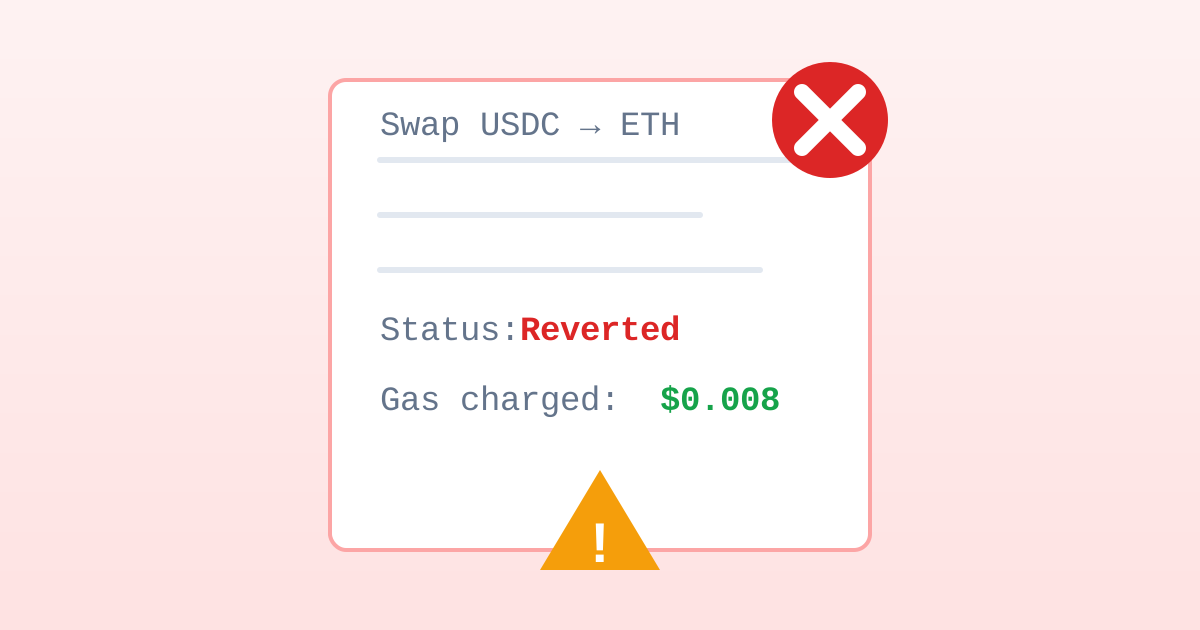
Real example from a volatile Tuesday, because abstract warnings are forgettable: I tried a USDC→ETH swap during a CPI print at 0.5% slippage. Reverted — $0.008. Retried at the same setting out of stubbornness. Reverted — $0.009. Widened to 2% and it landed instantly, having paid 0.4% worse execution than my original quote would've been — on a $600 trade, that's about $2.40 of "cost." The reverts cost me under two cents; the impatience cost two dollars and change.
That's the actual shape of L2 failure economics in 2026: the gas you burn failing is noise, but the behavior failures — wrong slippage, missing approval, empty gas tank — still cost real money in execution. Fix the habits, and failure becomes a rounding error on a rounding error. When in doubt, the full swap-cost breakdown shows where the real money in a trade actually goes (spoiler: the pool fee, never the gas).
Opere em Base / Arbitrum com Taxas Baixas
Escolha uma plataforma confiável para swap, bridge e operar em redes L2.
Links de afiliados — podemos ganhar uma comissão sem custo adicional para você.