Gas Limit vs Gas Price: The Wallet Setting Confusion That Cost Me $40
I edited the wrong box, twice
Early on, a swap sat pending for what felt like forever. I opened the advanced gas settings in my wallet, saw three intimidating fields, and did the confidently wrong thing: I raised the gas limit to speed the transaction up. Nothing happened. A friend then told me to raise the gas price, and when my first complicated transaction failed I swung the other direction and cranked the gas limit into the millions "to be safe." That one cost me about $40 in temporarily locked balance and a lot of confusion, though I got most of it refunded.
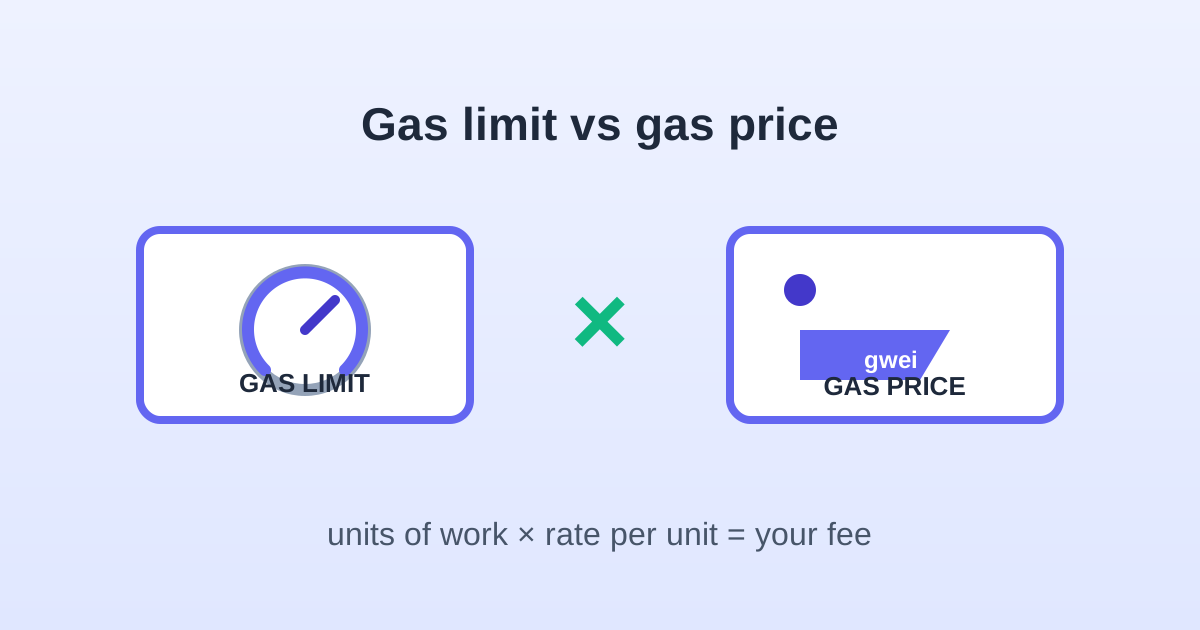
The two fields answer completely different questions. Once someone states them plainly, the whole fee system stops being mysterious: the gas limit is how much work your transaction is allowed to do, and the gas price is what each unit of work costs. The gwei unit itself is explained in the gwei guide; this article is about the two settings people actually touch.
The multiplication behind every fee
Every transaction fee follows the same primary-school formula:
A plain ETH transfer does exactly 21,000 units of work — that number is hardcoded into the protocol. If the price is 0.02 gwei on Base, the fee is 21,000 × 0.02 gwei = 420 gwei, worth roughly a few thousandths of a cent. A token swap is more computationally complex: it might use 140,000 units, but because each unit is nearly free the total still lands around a cent. Raising the limit on that pending swap changed the maximum allowed work, not the price per unit — which is why it did nothing for speed.
Think of it like shipping a package. Gas units are the weight of the contents, set by what the transaction actually does. The gas price is the per-kilo rate, set by network demand. You cannot make delivery faster by declaring a heavier package; you pay the faster rate.
What happens when each setting is wrong
| Setting | Too low | Too high |
|---|---|---|
| Gas limit | Transaction reverts "out of gas"; you pay for the work done but nothing executes | Harmless — unused units are refunded; only the balance is temporarily held |
| Gas price / max fee | Transaction waits or gets stuck pending | Expensive — you actually pay up to the rates you signed |
That refund row is the part nobody tells you: your wallet temporarily reserves gas limit × max fee as a "spending allowance," but after the transaction settles you are only charged for the units actually consumed. A fat gas limit does not donate money to anyone. A fat gas price absolutely can — under EIP-1559 you pay the current market base fee plus your priority tip, and a wildly high max fee simply means you authorized a wildly high worst case.
EIP-1559: why your wallet shows two prices now
Since EIP-1559, the single gas price field split into two that you see in the advanced editor:
- Max fee per gas is the ceiling you authorize — the network may never charge it.
- Max priority fee (the tip) is what you are willing to pay the block producer on top of the burned base fee to get included.
The base fee is burned, fluctuates block by block according to congestion, and is the same for everyone. If your max fee exceeds the base fee plus the going tip, your transaction qualifies for inclusion; the difference is refunded. On Base and Arbitrum the mechanism is inherited from Ethereum but the numbers are tiny, so in day-to-day use the wallet estimate is right and manual editing is almost never worth it — unlike the mainnet era where a wrong tip could stall a transaction for an hour.
Real gas-unit numbers on Base and Arbitrum
| Action | Typical gas units | Typical cost on L2 |
|---|---|---|
| Native ETH transfer | 21,000 | <$0.001 |
| ERC-20 approval | ~46,000 | $0.001-0.01 |
| ERC-20 token transfer | ~65,000 | $0.001-0.01 |
| Uniswap-style swap | 120,000-200,000 | $0.003-0.02 |
| LP add / remove | 200,000-400,000 | $0.01-0.05 |
| Complex contract / mint | 300,000-1,000,000+ | $0.02-0.20 |
One Arbitrum wrinkle: receipts split the bill into an L2 execution fee (the units math above) and an L1 data fee for posting compressed data back to Ethereum. The L1 portion follows mainnet congestion, not Arbitrum gwei, so an Arbitrum transaction can cost more than the local gas price suggests. The full breakdown lives in the Arbitrum fee explainer.
When I ever override the defaults
Almost never — and that is the honest answer for 95% of transactions. Wallets simulate your transaction, estimate the units, and pad the limit by 20-50%. On Base and Arbitrum the fee differences between "eco" and "urgent" are measured in thousandths of a cent, so manual tuning saves nothing you can notice. I open the advanced editor in exactly three situations:
- A transaction is genuinely stuck. Then I raise the max fee, never the limit, and usually I instead speed up or cancel through the wallet flow described in the pending transaction guide.
- A weird contract estimates oddly. Some mints and bridges underestimate units and revert with "out of gas." Adding 20-30% to the limit is safe because unused units come back.
- I am about to sign something suspicious. A simple-looking interaction requesting a multi-million gas limit is a red flag — heavy computation can hide abuse. I reject and investigate rather than edit.
When a transaction does fail, resist the urge to spam resends with higher limits. The diagnostic flow in failed transactions on L2 separates genuine out-of-gas reverts from the approvals, slippage, and stale-quote errors that masquerade as gas problems.
The mental model to keep
Limit = the work budget, padded automatically, safe to overstate, fatal to understate. Price = the rate per unit, refunded when below your ceiling, genuinely expensive when set too high. Speed is a price decision; failure is usually a limit decision. Keep those two sentences in your head and the advanced gas screen loses all its menace — which, on chains where a swap costs a cent, is exactly as simple as it should be.
Trade on Base / Arbitrum with Low Fees
Choose a trusted platform to swap, bridge, and trade on L2 networks.
Affiliate links — we may earn a commission at no extra cost to you.